

About the identification of Himalayan (Gyps himalayensis) and Eurasian (Gyps fulvus) Griffon vultures
Part 2, four more difficult birds
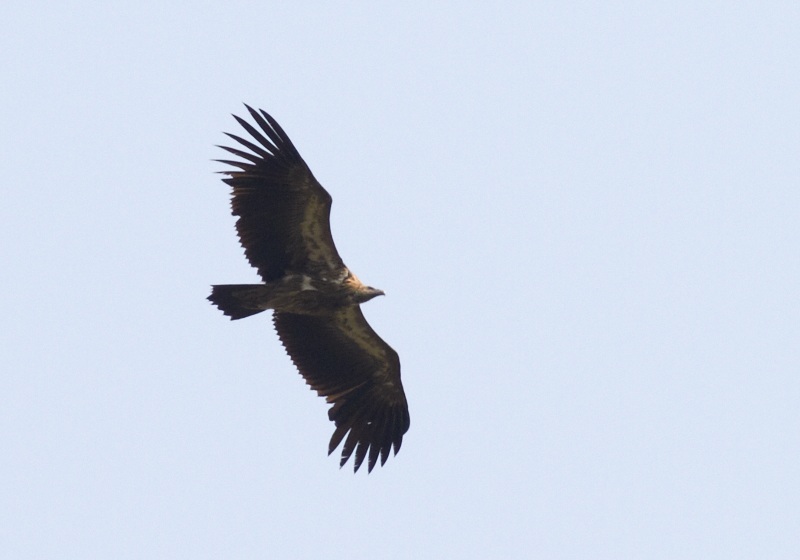
(1.) Subadult Himalayan Griffon. 3 April 2010 Kaziranga, Assam, India. A second-year bird with a full set of unmoulted juvenile secondaries. Also, the underside of the body is still quite juvenile-like. There are irregular, patchy pale areas on the underwing-coverts, and the patagial bar is hardly separable from the central bar. Eurasian Griffon may show quite a large pale area on the underwing-coverts, but it is typically a more uniform longitudal central bar while the patagial bar is still separable from the central bar. (The opposite is not true, subadult Himalayan often shows a uniform, large central bar as well as distinct patagial bar like typical Eurasian Griffon)
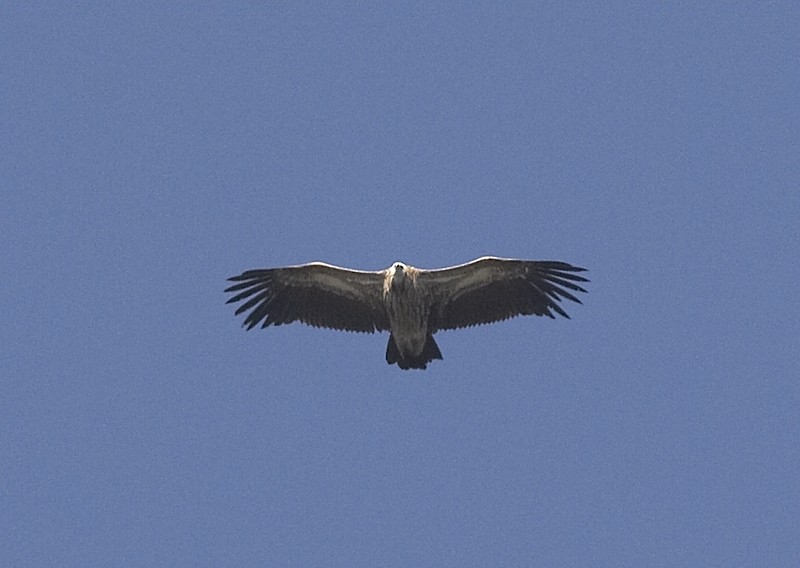
(2.) Subadult Himalayan Griffon Vulture. Pangot, Uttarakhand, India, 24 November 2007. 2nd cy bird still with a full set of juvenile secondaries. It seems that most of the underbody has been moulted, and the pale stripes are broader than in juveniles, but quite different from the pattern of Eurasian Griffons.
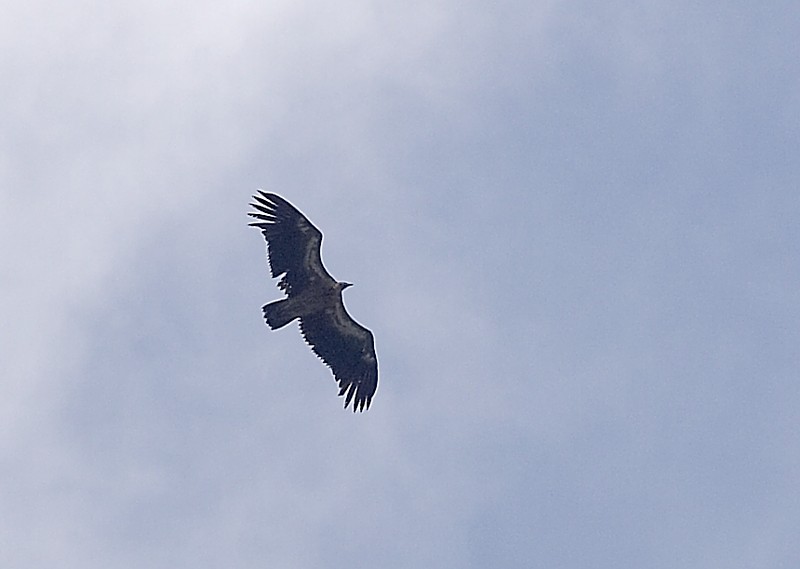
(3.) Subadult Himalayan Griffon Vulture. Barthogai, Almaty province, Kazakstan, 24 May 2008. This bird seems to be in its third calendar-year: secondaries are still juvenile, but about two inner primaries have been moulted (but probably no ongoing moult - on the other hand, some April photos from India show the second primary growing in a presumed second-calendar-year bird). The appearance of the underwing-coverts have changed a lot, but the underbody is still juvenile-like, but probably moulted once. Very broad wings and proportionately small head make it look like a Himalayan Griffon structurally, but structural differences are not always easy to see in lone birds.
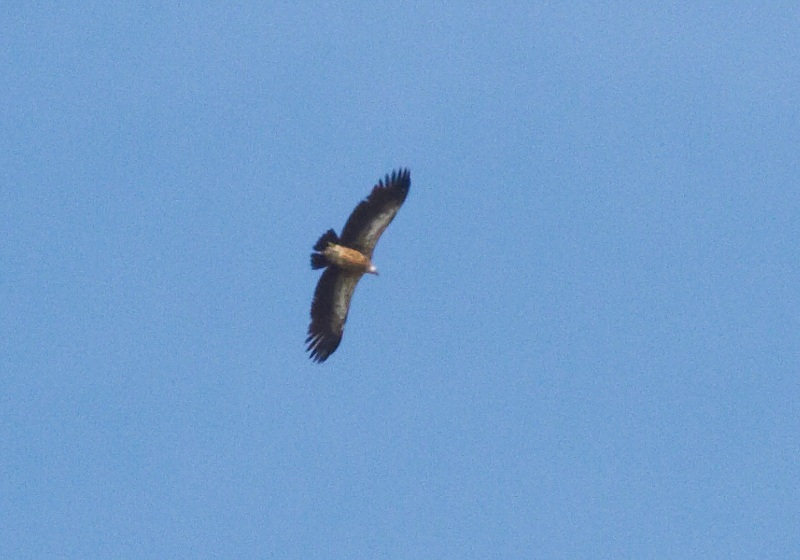
(4.) The most difficult photo in this set, partly because the bird was not seen very well in the field. Elangash, Altai Republic, Russia, 23 June 2010. The body seems to be somewhat rufous, and the wings are not very broad. However, the body seems to be large and thick and the head proportionately small, as in Himalayan Griffon. Also the pattern of the underwing coverts supports the identification as a subadult Himalayan Griffon: Eurasian Griffon may show this much whitish colour, but it occurs as a longitudal central bar with a separate patagial bar visible. Also, the black greater coverts of Eurasian Griffon should be visible in this photo. In the field, the bird appeared to be about the same size as the accompanying Cinereus Vulture (Aegypius monachus).